












Elias Konstas | Mechanical Engineer | Vietnam
Elias Konstas | Mechanical Engineer | Vietnam
Elias Konstas worked for many years in Saigon, Vietnam, from which he left with many nice memories. Today he lives and works in a Middle Eastern country. He will definitely have a lot to tell us about Vietnam, where he stayed for many years.
Tell us a few things about yourself and your professional activity
I am a Mechanical Engineer and I deal with Metro and Tram projects, in technical management, railway vehicle technology, testing and maintenance. The development of such projects around the world attracts professionals in the field who move from project to project. I moved to Saigon (Ho Chi Minh City) in 2015 when I was offered a job by a Japanese company that had undertaken the construction of the first subway line in the city.
Can you tell us a few things about Saigon, where you lived and worked professionally for many years, about Vietnam, the culture, etc.
The city was renamed Ho Chi Minh, in honor of the North Vietnamese leader, after its occupation in 1975. Since then, it has grown and today reaches 8.5 million inhabitants with an obvious traffic problem, like most Asian megacities. The Saigon brand, however, survives for residents of the old center and in shops and tourist services. It has not reached the level of development of Bangkok or Kuala Lumpur but it has made leaps and bounds in the last decade, like all of Vietnam.
Large numbers of rural population have moved there in search of work. Many live in rooms costing $80 a month and buy street food for a couple of dollars a day. The average salary of an office worker can be around $250 per month. Their movement is mainly done by motorbikes which are found by the hundreds at every moment at the intersections and also on the sidewalks when it is convenient.
Tip: when standing on the pavement look behind you for oncoming motorbikes because it is common for them to climb onto accessible pavements and when crossing the road between dozens of motorbikes walk steadily so that the bikers can calculate whether to overtake you from the front or the back. If you change your step or hesitate you confuse them and an accident can occur!
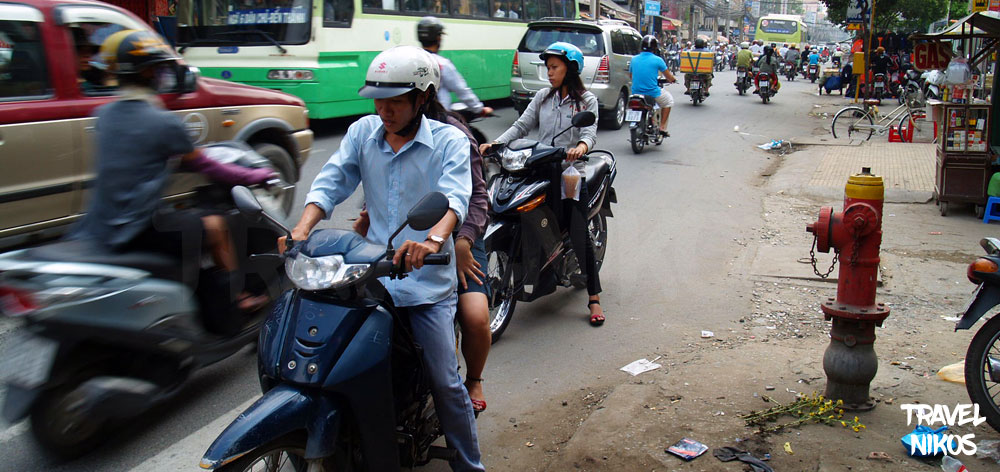
Saigon, Vietnam, rush hour
Speaking of accidents, less happens than the huge number of two-wheelers would statistically suggest. The reason is the low speeds they move, so collisions usually don’t have big consequences.
But motorbikes are really a way of life for the locals. They cost from 300 dollars for the economic Chinese ones, up to 1000 dollars for the Japanese ones.
No one sees large displacement engines. They move with them, put them in their apartment, up there they have fun with a juice from the street, there they flirt. There is no Vietnamese over 16 who does not own a motorcycle.

The people are very friendly and the country quite safe. The only exception is the possibility of pickpockets or pickpockets taking away your cell phone, so you don’t expose it in public. But girls can be alone in the center of Saigon at any time of the 24 hours without danger.
Western female tourists traveling the country told me that nowhere else have they felt so safe traveling alone.
Another characteristic that as a foreigner I found enviable is the absolute commitment to everyday life. Nothing could disturb her and you could plan exactly what you were going to do 3 months from now. Shops were open 7 days a week 10 to 10, strikes and demonstrations did not exist (status quo) so everything was a given. An occasional rainstorm could make traffic difficult, but that’s about it.
Yes, the conditions are not particularly democratic, as the locals vote for municipal and regional elections, but in the national ones the list is drawn up by the party and you choose from them. But for a foreigner without electoral rights or political concerns, these are conditions in which he can plan his business and his life. It is no coincidence that many Europeans or Australians choose Vietnam as a place of retirement. The warm climate, friendly people, stability and low cost of living are conditions suitable for spending the retirement years.
In addition, unlike China, there is no censorship of the media and social media so one does not feel excluded from information and communication. Entrepreneurship and investment present several opportunities.
Areas where the country still needs improvement are in health services and recycling. But I have seen improvement movements in these directions, so in 20 years I think they will have reached a satisfactory level.
In which other parts of Vietnam (but also in Asia) have you traveled, some beaches, islands that left you speechless?
In Vietnam I have visited the Mekong River Delta, the beach resort of Nha Trang, the old town of Hoi An with French colonial style but also influences from Chinese fugitives from the 19th century Emperors. Also Hanoi but the place that really blew me away was Ha Long Bay.
You will have seen it in various movies with the thousands of rocks and islands emerging like meteors from the sea. One can visit them with cruises in baton mousse for a few hours or even for whole days, to see floating villages and unique landscapes. But at least one overnight stay in the island bays is an amazing experience. The night, absolute silence and the sunrise rosy on a cluster of verdant rocks.
Other places in Asia that I have visited are Singapore which is by far the most developed and cleanest place in South East Asia and a good place to stay if you can handle the increased cost of living, Kuala Lumpur which touristically sells out in a fortnight but to living there is good, Bangkok which is a huge city with unimaginable traffic but also many monuments and sights to visit, Cambodia with the unique archaeological site of Siem Reap (Angor Wat) but the rest of the country is rather behind touristically and not particularly safe, Hong Kong which I found expensive and “tired” as a city, has not progressed spectacularly since the 70s when it was the first city in Southeast Asia.
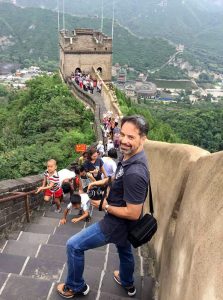
I also visited South Korea professionally with civilized and kind people, a beautiful Seoul although the rest of the provincial cities lag behind in architecture and elegance and extreme climate between winter and summer, Japan which is a country with many natural beauties and cities like Kyoto and Nara with traditions from the Shogun and Samurai era and Tokyo which is more beautiful and more human than the impression conveyed by television lenses and China from north to south which I must say I consider the least attractive country for tourism and residence from the rest of the Southeast Asian countries.
Somewhat more beautiful are its warm southern cities such as the watery Suzhou and Shanghai in contrast to the industrial and depressing north with harsh Winters.
What do you miss from Greece?
Many things. I think they have wronged our country on multiple levels. Things that bother us or repel us like red tape, barriers to doing business and general crime are fixed with a determined government. The positives we have such as geographical location, mild climate, natural beauty (and I am referring not only to the summer but also to the overlooked winter destinations), highly trained specialized scientific potential can give us competitive advantages and catapult us developmentally.
0 Reviews
Write a Review
Sponsored Ad
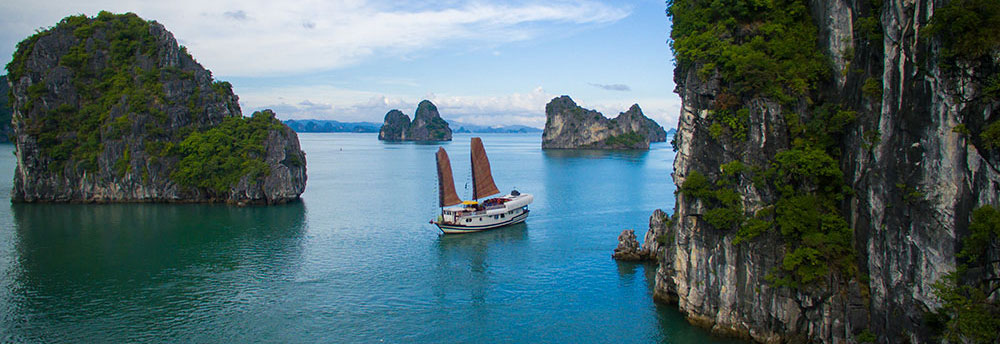
Halong Bay Cruises
Discover Southeast Asia's stunning scenery and enjoy an unforgettable experience in one of the most popular destinations