













Thomas Katsonis | Civil Engineer | Singapore
Thomas Katsonis | Civil Engineer | Singapore

Thomas is an incredibly good and sophisticated photographer (the photo shows it anyway) and who loves to travel. I could place him as a talented photographer because his work is fascinating. Permanent resident of Singapore where he works as a civil engineer. You will find his website at the following address: www.ergoandplan.com. Thomas, who also loves Southeast Asia, will certainly have a lot to tell us about these tropical countries of the world, which are popular destinations. In order not to write too much, let’s see them, he tells us.
How did it end up in Southeast Asia?
I first came to Southeast Asia in the summer of 2008 when I came to wander at the urging of a travel agency, after I had traveled almost all over Europe and wanted to see other cultures besides the West.
That first journey of wandering, though not finished to this day, had many returns to Greece and back again to the East.
Which countries have you visited and a few words about them, impressions?
Now permanently based in Southeast Asia since January 2013 I have visited Singapore, Malaysia, Thailand, Laos, Vietnam, Hong Kong and Osaka, Japan. The conditions in all areas are completely different from the common “data” known to the world. The contrasts and shifts in the images are stunning.
A place or places in Southeast Asia that you particularly liked?
The places I could single out based on my own preferences are Singapore first and then Osaka, Japan. All the other places I have mentioned have of course their peculiarities and are rich in beauties, natural beauty of landscape – people – and cultural characteristics, but Singapore and Osaka “shaken” me and changed me completely.
What is Singapore to you?
Singapore gave me the opportunity to create in the field in which I am active as a civil engineer and to leave the narrow and limited data that Greece gave me when I started my profession. It is a center of architecture and has open minds that accept new proposals and new technologies.
What is the future of the area where you live?
Singapore exists as both an island and a city-state and regionally appears to have areas of building saturation for residential use along a considerable length of its eastern coastline. Nevertheless, the industrial-shipping sector is rapidly developing and is the one that has brought Singapore to the top positions worldwide.
What did you gain from your travels?
Traveling means constantly reading an encyclopedia. The stimuli he receives every day turn into valuable experiences that indirectly become capable of providing answers and solutions to everyday issues.
Could you also tell us a few words about Japan, where you were also active professionally?
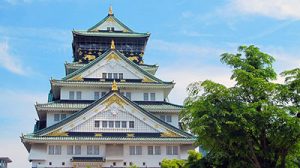
Οσάκα της Ιαπωνίας
Recently for just one semester I had to be in Osaka, Japan for business reasons. I would describe Japan in general as a raw, but at the same time precious stone.
The Japanese are an incredibly intelligent people. If one manages to get past their discomfort with their social behavior, one will discover that they are an incredibly industrious people and fully committed to whatever they undertake. If they understand and trust you, then you become their mentor.
Morphology of skyscrapers, article by Thomas Katsonis

I would like to deal with something for which there is no significant construction example in our country. The lack of tall buildings in Greece is not only due to the inexperience of the engineers, but also to the obstruction of their construction by the statutory General Building Regulation, which explicitly prohibits buildings over 27 meters. Buildings which, however, would be symbols and poles of attraction for various stakeholders.
To date the tallest building in the world is the Taipei Tower in Taiwan with a height of 509 meters. This record has already been broken by the unfinished Burj Dubai tower in Dubai which is currently over 818 meters high. The construction of ever taller buildings overturns basic design principles. While one would expect that in such a structure earthquake would be the most unfavorable load, this is not the case. In fact, the biggest burden comes from the wind.
High wind speeds cause strong loads resulting in large amplitude oscillations in the upper floors. And here comes the inconsistency of building engineering. Strong loads require a more rigid construction, with a direct consequence on the overall cost, but with a greater sense of security for the building’s occupants.
For this reason, all tall buildings are tested at the design stage in a wind tunnel, just like airplanes and cars. A common practice in the design of such buildings is for engineers to develop and assess the strength of a first settled design. As long as the required strength is achieved, the study proceeds further.
Has anyone wondered why there are surface interventions on the surface of skyscrapers and not a simple geometric volumes in the form of a vertical column? Fluid mechanics comes to explain the reason. It is known that when a solid body is in an air current, pressures develop on the windward side and negative pressures on the leeward side. This translates as follows: on the windward side there is a force that pushes the body. The same happens on the leeward side. The negative pressure also creates a force, which pulls the body.
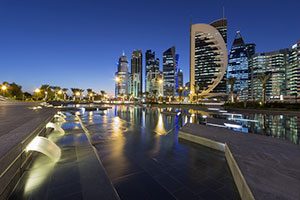
These two forces have the same direction, so when added together they greatly burden the solid with strong movements and consequently oscillations. In this case of skyscrapers, in order to limit the movements, their stiffness must be increased with a direct impact on the cost of the construction. In order to limit the oscillations, the following strategy is applied in the design of tall buildings. The morphological discontinuity, or to make it more clear the surface irregularities, on their surface throughout their height reduce the width of the leeward area resulting in a reduction of the corresponding attractive force and the total force acting on the building.
As for the burden caused to the construction by the earthquake, this is dealt with by the appropriate shock absorbers in the foundation of the building. They are probably the main element of seismic shielding of newly erected structures. Their beneficial effect is due to the reduction of seismic energy due to the damping of a part of it. Morphologically, they resemble huge rubber barrels which are inserted between the main foundation of the building and its frame.
Certainly, special know-how is needed for the construction of such projects. My opinion is that Greek engineers are not lagging behind neither in knowledge nor in technological abilities. With the support of the state, this construction horizon can also be opened in our country. The private sector is always waiting.
Thomas Katsonis
Civil Engineer A.P.Th.
0 Reviews
Write a Review
Sponsored Ad
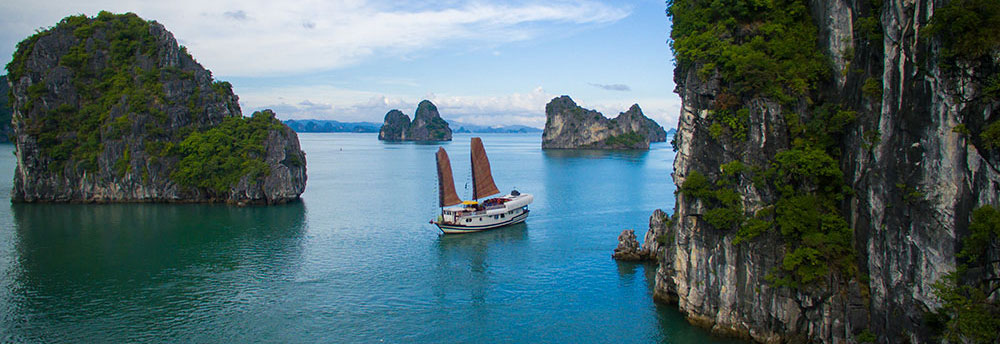
Halong Bay Cruises
Discover Southeast Asia's stunning scenery and enjoy an unforgettable experience in one of the most popular destinations